Student Spotlight
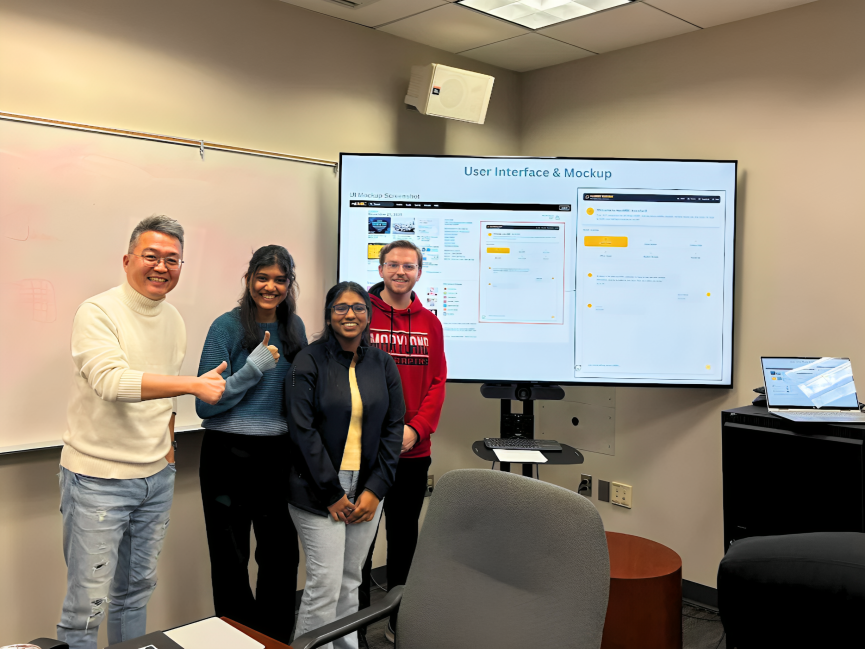
Three Information Systems graduate students, Pavithra Gottipati, Andrew Meiller, and Sakshi Jaju teamed up in IS 636 – Structured Systems Analysis and Design, taught by Lei Zhang, to design and prototype an AI-powered chatbot for the myUMBC portal. Their project focused on improving how students find answers and get support across campus services.
The Project
Problem Statement: Build an AI-powered chatbot in the myUMBC portal to support students with common questions and service requests.
The chatbot is designed to:
- Answer student questions
- Provide direct links to helpful campus resources
- Escalate complex issues to human support
Scope:
The chatbot serves both undergraduate and graduate students and supports topics such as billing, financial services, library resources, career services, and IT support. It integrates with myUMBC Help/Request Tracker and Student Business Services, and includes analytics, monitoring, and admin tools.
Impact:
By giving students a single point of contact for billing, payments, library resources, jobs, and IT support, the chatbot helps reduce repetitive tickets, improve response times, and increase overall student satisfaction. Since UMBC already has strong guides and ticketing workflows, the system builds on existing resources to scale support while keeping interactions accurate and efficient.
Team Roles
Sakshi Jaju
Led the design of the user interface and interaction flow, and developed high-fidelity prototypes.
Pavithra Gottipati
Led development of the core chatbot engine, NLP model integration, and server-side logic.
Andrew Meiller
Led project documentation, presentation flow, user research, and comprehensive system testing.
Tools, Technologies, & Skills
The team implemented a Retrieval-Augmented Generation (RAG) approach:
- A sentence transformer model retrieves the closest FAQ using vector embeddings
- The Microsoft Phi-3 Mini Instruct LLM generates fallback responses when no close match is found
- Secure NLP/LLM hosting, integrated knowledge base, and API connectivity within the UMBC ecosystem
Design and research methods included:
- High-fidelity prototyping in Figma
- Stakeholder interviews
- Usability testing
- Interaction flow design

What They’re Excited to Keep Learning
Sakshi Jaju:
“I’m most excited to continue developing my skills in UI research and interaction design. I want to better understand how users think, behave, and navigate digital systems so I can design more intuitive and accessible experiences.”
Pavithra Gottipati:
“I’m especially excited to deepen my knowledge of Large Language Models (LLMs) and get more hands-on experience building and improving AI-driven systems.”
Andrew Meiller:
“I’m most interested in how AI relates to cybersecurity. New threats are emerging, and I want to learn how to protect data and use AI to help defend against them.”
Projects They’re Most Proud Of
Sakshi Jaju:
“I’m proud of leading the UI/UX design for the myUMBC AI-powered chatbot and contributing to the HCC Ph.D. website revamp. These projects helped me apply human-centered design in real-world contexts and make a tangible impact on the UMBC community.”
Pavithra Gottipati:
“I’m proud of building the logic behind a RAG-based system with an LLM fallback. It helped me better understand AI system design and architecture.”
Andrew Meiller:
“I’m most proud of my ongoing research on post-quantum computing and how it relates to cybersecurity. As computing power grows, we’ll need new ways to protect our information.”
Looking Ahead: Career Goals
Sakshi Jaju plans to complete her Master’s in Human-Centered Computing and pursue a career in UI/UX or product design, creating accessible and user-centered digital experiences.
Pavithra Gottipati aims to work in software engineering or AI-focused application development, building intelligent systems with real-world impact.
Andrew Meiller hopes to work in cybersecurity for a government or public institution, helping protect sensitive data as technology evolves.
Beyond the Classroom
Outside of their coursework, the team stays active in ways that connect directly to Information Systems and related fields:
Sakshi Jaju applies UX and visual communication skills as a social media content creator, has completed eight Google UX Foundation certification courses, and brings creativity from her background in Bharatanatyam (Indian classical dance).
Pavithra Gottipati strengthened her technical and problem-solving skills through a CodePath course and continues building hands-on development projects beyond class.
Andrew Meiller served as Event Coordinator for the Information Systems Council of Majors, helping organize events for early-year students to learn about IS programs, certifications, and pathways at UMBC.
Advice for Other Students
Start building and exploring early, even if you don’t feel fully ready. Focus on what you truly enjoy and practice it consistently. Hands-on experience often teaches more than theory alone. Stay curious, try new things, and be open to unexpected opportunities.
To learn about about these students and their work, please follow the links below:
Sakshi Jaju
https://www.linkedin.com/in/sakshi-jaju-98071820b/
https://www.instagram.com/sakshi_jaju19/
Pavithra Gottipati
https://www.linkedin.com/in/pavithra-gottipati-8b0b351b9/
https://www.instagram.com/pavithra_gottipati/
Andrew Meiller
https://www.instagram.com/ameiller813/